0 views
Share this clip
Know someone who'd love this clip?
Share it with friends and fellow fans.
Share this clip
Know someone who'd love this clip?
Share it with friends and fellow fans.
The Chevrolet Corvette (C1) is the first generation of the Corvette sports car produced by Chevrolet. It was introduced late in the 1953 model year and produced through 1962.[4] This generation is commonly referred to as the "solid-axle" generation, as the independent rear suspension did not appear until the 1963 Sting Ray. The Corvette was rushed into production for its debut model year to capitalize on the enthusiastic public reaction to the concept vehicle, but expectations for the new model were largely unfulfilled.[5] Reviews were mixed and sales fell far short of expectations through the car's early years. The program was nearly canceled, but Chevrolet decided to make necessary improvements. The most expensive Corvette (C1) to sell in history was sold by Barrett-Jackson in the United States in March 2021 for $825,000 (~$883,234 in 2022) (£591,470).[6] History Origins Harley Earl, as head of GM's Styling Section, was an avid fan of sports cars. He recognized that GIs returning after serving overseas in the years following World War II were bringing home MGs, Jaguars, and Alfa Romeos.[7] In 1951, Nash Motors began selling an expensive two-seat sports car, the Nash-Healey, that was made in partnership with the Italian designer Pininfarina and British auto engineer Donald Healey,[8] but there were few moderate-priced models.[9] Earl convinced GM that they needed to build an all-American two-seat sports car, and with his Special Projects crew began working on the new car in late 1951. The last time Chevrolet offered a 2-door, 2-passenger convertible/roadster body style was in 1938 with the Chevrolet Master.[10] Prototype EX-122 The secretive effort was code-named "Project Opel" (after GM's German division Opel).[9][11] The result was the hand-built, EX-122 pre-production Corvette prototype, which was first shown to the public at the 1953 General Motors Motorama at the Waldorf-Astoria in New York City on January 17, 1953. When production began six months later, at an MSRP of US$3,513 ($38,425 in 2022 dollars [12]), it had evolved into a considerably costlier car than the basic $2,000 roadster Harley Earl originally had in mind.[13] The EX-122 car is now located at the Kerbeck Corvette museum in Atlantic City and is believed to be the oldest Corvette in existence.[14] Design and engineering To keep costs down, GM executive Robert F. McLean mandated off-the-shelf mechanical components. The new car used the chassis and suspension design from the 1949 through 1954 Chevrolet passenger vehicles. The drivetrain and passenger compartment were moved rearward to achieve a 53/47 front-to-rear weight distribution. It had a 102 in (2,591 mm) wheelbase. The engine was a 235 cu in (3.85 L) inline six engine[15][2] that was similar to the 235 engine that powered all other Chevrolet car models, but with a higher-compression ratio, three Carter side-draft carburetors, mechanical lifters, and a higher-lift camshaft. Output was 150 hp (112 kW). Because there was currently no manual transmission available to Chevrolet rated to handle 150 HP, a two-speed Powerglide automatic was used. The 0–60 mph (0–97 km/h) time was 11.5 seconds. Three body variants were created. The roadster was built as the Corvette, the Corvair fastback variant never went into production, and the two-door Nomad station wagon was eventually built as the Chevrolet Nomad.[16][2]
A car, or an automobile, is a motor vehicle with wheels. Most definitions of cars state that they run primarily on roads, seat 1-8 people, have four wheels, and mainly transport people rather than cargo. There are over 1.6 billion cars in use worldwide as of 2025. The French inventor Nicolas-Joseph Cugnot built the first steam-powered road vehicle in 1769, while the Swiss inventor François Isaac de Rivaz designed and constructed the first internal combustion-powered automobile in 1808. The mode...
More about Car→Added
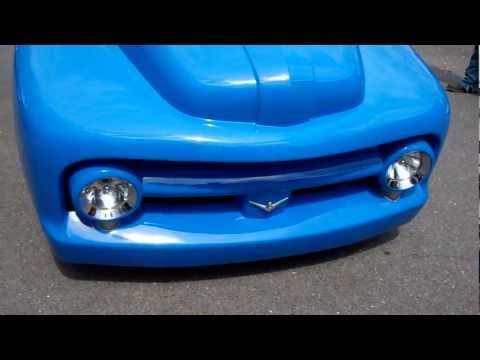 5:20
5:201952 Ford
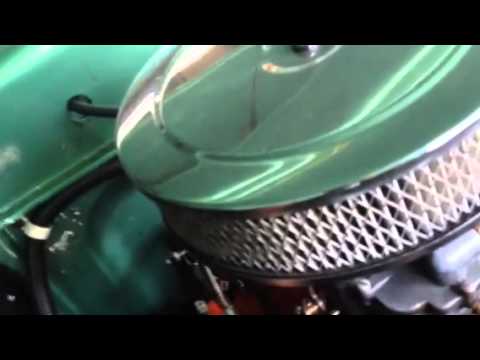 1:48
1:481952 Ford
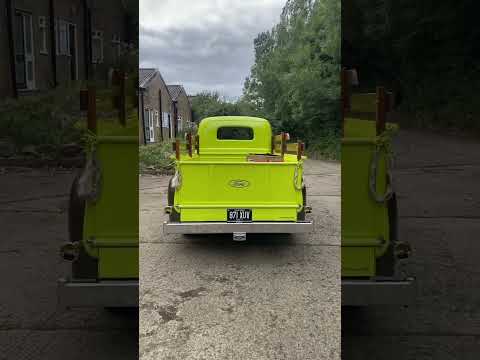 0:27
0:27 1:43
1:431952 Ford