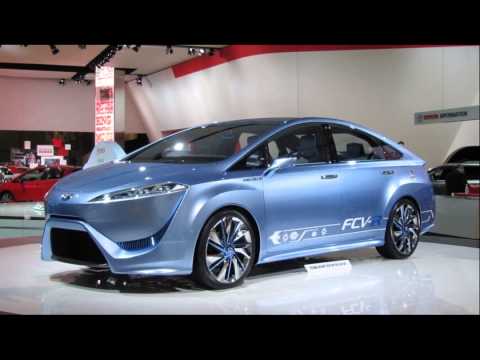
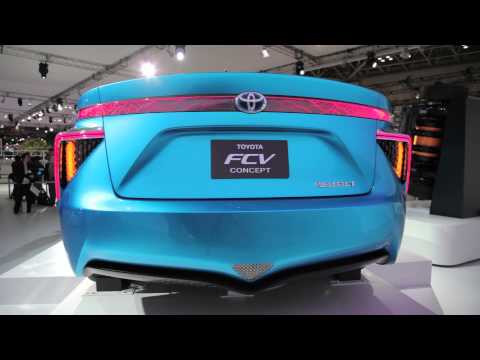
TOYOTA FCV-R (2012) Concept
Toyota believes that, when it comes to the development of future powertrains to safeguard sustainable mobility, one size definitely does not fit all requirements. Different powertrain needs and solutions are determined not only by vehicle size and travel distance, but also by regional variations in energy availability, infrastructure and regulations. As hybrid, plug-in hybrid, electric and fuel cell vehicles replace most of today's conventional cars, electric vehicles will be used for short-distance travel, and fuel cell vehicles for middle- to long-distance journeys. Reinforcing the company's environmental lead in the drive towards sustainable mobility, Toyota's Hybrid Synergy Drive® technology has been specifically designed to be 'future proof', and is readily adaptable to use in Plug-in Hybrid Vehicles (PHEV), Electric Vehicles (EV) and Fuel Cell Vehicles (FCV). The Significance of Fuel Cell Technology Toyota believes that the solutions to energy and emissions issues offered by the Fuel Cell Vehicle (FCV) make it the closest technology yet to the ultimate eco-car, with hydrogen as an ideal, ultra-clean energy source. Producing electricity through a chemical reaction between hydrogen (stored in the vehicle) and oxygen (from the air), a fuel cell structure comprises electrodes and polyelectrolyte films sandwiched between separators. When hundreds of cells are stacked together, the result is a fuel cell 'stack', known as an FC stack. Generating zero CO2, NOx or PM and with water vapour the only emission, a fuel cell displays outstanding energy efficiency. In theory, it can convert as much as 83% of hydrogen's energy into electric power. This is about twice the efficiency possible with current generation petrol and diesel engines. Not only does a hydrogen fuel cell powertrain's extreme efficiency save energy and drive down costs, it also delivers a uniquely quiet, smooth driving experience with the bare minimum of noise, vibration or harshness, while providing a long driving range and a refuelling process as quick as that of conventionally powered vehicles. Key Challenge: The Hydrogen Infrastructure Offering future global energy security, hydrogen can be made from a wide variety of raw materials, from petroleum and natural gas to biomass. It can also be produced through the electrolysis of water. Carrying out electrolysis using electricity generated from natural energy sources such as solar, wind or hydro-power enables the production of hydrogen without the commensurate generation of significant CO2 emissions. Nonetheless, a smooth shift to a hydrogen-based society will be a significant undertaking. Reaching a consensus on from what to make hydrogen, how to deliver it and how to implement a fuelling infrastructure depends on the combined efforts of all sectors of society, including governments. To that end -and in anticipation of the imminent commercialisation of a number of FCVs - Toyota, amongst other manufacturers, signed a Letter of Understanding in September 2009 calling for oil and energy companies and government organisations to cooperate in the creation of hydrogen infrastructure networks of sufficient density in Europe, Japan, Korea and the United States in 2015. In Europe, a hydrogen infrastructure has already begun to emerge. It is of sufficient density to allow Toyota to road test and build the profile of hydrogen fuel cells as a viable powertrain.
About Toyota FCV
The Toyota Mirai is a mid-size hydrogen fuel cell vehicle (FCV) manufactured by Toyota, and is the first FCV to be mass-produced and sold commercially. The Mirai was unveiled at the November 2014 Los Angeles Auto Show. As of November 2022, global sales totaled 21,475 units; the top-selling markets were the U.S. with 11,368 units, Japan with 7,435 and the rest of the world with 2,622.
More about Toyota FCV→Added
Know someone who'd love this clip?
Share it with friends and fellow fans.