American Motors Corporation — Rare Footage & Clips
American Motors Corporation (AMC) - a name that echoes through the annals of American automotive history like a distant rumble of thunder on a summer evening. Born from the merger of Nash-Kelvinator Corporation and Hudson Motor Car Company in 1954, AMC would go on to carve its own niche in the market, defying convention with innovative designs, robust engineering, and an unwavering commitment to quality.
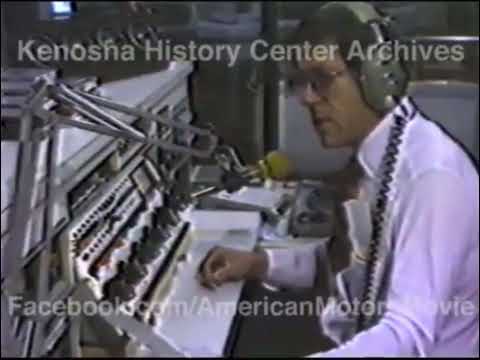
A cursory glance at the archive reveals two fascinating clips that offer a glimpse into the inner workings of this American icon. "American Motors Corporation Factory Tour Old Footage from the Kenosha History Center" is a treasure trove of behind-the-scenes action, showcasing the assembly lines where AMC's most beloved models were born. Meanwhile, "The Life and Death of American Motors Corporation: RCR Car Stories" (1983) provides a poignant retrospective on the company's rise and fall, as told through the eyes of those who lived it.
One cannot help but be struck by the sheer scale of AMC's ambitions. As the largest corporate merger in U.S. history at the time, the company's formation signaled a seismic shift in the automotive landscape. With its sights set firmly on the Big Three - Ford, General Motors, and Chrysler - AMC was determined to carve out a distinct identity for itself. And so it did, with a range of models that would come to define the brand: the Rambler American, Hornet, Gremlin, and Pacer; intermediate and full-sized cars like the Ambassador, Rambler Classic, Rebel, and Matador; muscle cars in the form of the Marlin, AMX, and Javelin; and even early four-wheel drive variants of the Eagle and Jeep Wagoneer.
But AMC's significance extends far beyond its impressive product lineup. In an era where music was beginning to break free from its shackles, AMC found itself at the forefront of a cultural revolution. The 1960s were a time of great change, with the likes of Bob Dylan, The Beatles, and Jimi Hendrix pushing the boundaries of artistic expression. And it's no coincidence that AMC's most iconic models - the Javelin and AMX, in particular - found themselves at the center of this maelstrom.
The Javelin, with its sleek lines and aggressive stance, was the very embodiment of 1960s cool. Its AMX sibling, meanwhile, was a high-performance variant that would go on to become an icon of American muscle. Both cars were tailor-made for the youthquake generation, who were eager to express themselves through their vehicles. And it's here that AMC's connection to music history becomes clear: these cars were not just mere machines; they were status symbols, reflections of a bygone era when rebellion was in the air.
The Javelin, with its distinctive finned tail and aggressive grille, was the perfect vehicle for the likes of Jimi Hendrix, who would often be seen cruising the streets of Los Angeles in his cherry-red example. Meanwhile, the AMX - with its razor-sharp lines and thunderous V8 engine - was the car of choice for many a rock 'n' roll aficionado, including none other than Eric Clapton.
But AMC's influence extends far beyond the world of music. The company's innovative approach to design and engineering would go on to shape the very fabric of American automotive culture. Take, for example, the iconic Jeep Wagoneer, which was one of the first true crossovers in the U.S. market. This pioneering vehicle - with its rugged four-wheel drive system and spacious interior - paved the way for a new generation of SUVs that would come to dominate the roads.
And yet, despite its many achievements, AMC's story is ultimately one of tragedy. The company's struggles to compete with the Big Three would eventually prove too great, leading to its demise in 1988. But even in death, AMC's legacy lives on - a testament to the power of innovation and determination in the face of overwhelming odds.
As we delve deeper into the archive, it becomes clear that AMC's story is one of resilience, of a company that refused to be defeated by the forces of convention. From its humble beginnings as a merger between two struggling manufacturers to its eventual rise as a major player in the American automotive market, AMC's journey is a fascinating tale of triumph and tragedy.
In "The Life and Death of American Motors Corporation: RCR Car Stories" (1983), we see firsthand the impact that AMC's demise had on those who worked for the company. The film is a poignant tribute to the men and women who poured their hearts and souls into building some of America's most iconic vehicles.
As we reflect on AMC's legacy, it becomes clear that its influence extends far beyond the world of cars. This was a company that embodied the spirit of American ingenuity, of innovation and determination in the face of adversity. And even as we bid farewell to this bygone era, we are reminded that the true power of AMC lies not in its vehicles themselves, but in the people who built them - and the music that they drove.
The archive's "American Motors Corporation Factory Tour Old Footage from the Kenosha History Center" offers a unique glimpse into the inner workings of AMC's manufacturing process. We see workers busily assembling engines, chassis, and body panels; we watch as cars are carefully inspected before being shipped off to dealerships across the country.
But what really sets this footage apart is its sense of nostalgia. There's something undeniably charming about watching workers in overalls and hard hats moving parts around a factory floor, their faces set with concentration as they work towards creating something truly special.
As we continue to explore the world of AMC, it becomes clear that this was a company that was deeply connected to its community. From its early days as a merger between two struggling manufacturers to its eventual rise as a major player in the American automotive market, AMC's story is one of resilience and determination.
In many ways, AMC's legacy serves as a reminder that even in an era of globalized manufacturing and homogenized design, there's still room for innovation and creativity. This was a company that refused to be bound by convention, instead choosing to forge its own path through the automotive wilderness.
As we look back on AMC's remarkable journey, it's clear that this was a company that left an indelible mark on American automotive culture. From its pioneering designs to its innovative approach to engineering, AMC's influence can still be felt today - in the cars we drive, the roads we travel, and the very fabric of our society.
In the end, AMC's story is one of triumph and tragedy, of a company that refused to be defeated by the forces of convention. And even as we bid farewell to this bygone era, we are reminded that the true power of AMC lies not in its vehicles themselves, but in the people who built them - and the music that they drove.
Curated from public records and music databases.