Toyota Mirai - Fuel Cell Vehicle - Toyota Introduction
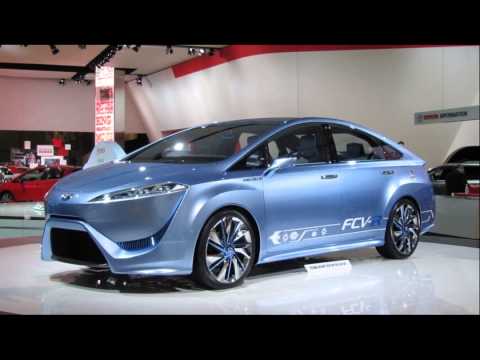
http://www.toyotaofgladstone.com (877) 565-5228 Learn more about the road Toyota traveled to arrive at the Toyota Mirai. This game-changing vehicle runs on hydrogen and emits only water while driving. About Toyota: We’re in the business of making great cars and trucks. But we also work every day to apply and share our know-how in ways that benefit people, the community and our planet in order to build a better tomorrow. We’ve been a part of life in America for over 50 years. And while we’re passionate about making great cars and trucks, our story is about much more than our vehicles. The Toyota Mirai (Japanese for "future") is a hydrogen fuel cell vehicle, one of the first hydrogen fuel-cell vehicles to be sold commercially. The Mirai was unveiled at the November 2014 Los Angeles Auto Show. Toyota plans to build 700 vehicles for global sales during 2015. Under the United States Environmental Protection Agency (EPA) cycle, the 2016 model year Mirai has a total range of 502 km (312 mi) on a full tank, with a combined city/highway fuel economy rating of 66 mpg-US (3.6 L/100 km; 79 mpg-imp) equivalent (MPG-equivalent), making the Mirai the most fuel efficient hydrogen fuel cell vehicle rated by the EPA, and the one with the largest range. FCV concept The Mirai is based on the Toyota FCV (Fuel Cell Vehicle) concept car, which was unveiled at the 2013 Tokyo Motor Show. The unveiled FCV concept was a bright blue sedan shaped like a drop of water "to emphasize that water is the only substance that hydrogen-powered cars emit from their tailpipes." The FCV has a large grille and other openings to allow cooling air and oxygen intake for use by the fuel cell. According to Toyota, the FCV concept is close in appearance to the expected production version of the car. The FCV size is similar to the Toyota Camry. The FCV range is expected to be approximately 700 km (430 mi) under Japan's JC08 test cycle. Toyota FCV concept car According to Toyota, the FCV features a fuel cell system with an output power density of 3.0 kW/L, which is twice as high as that of its previous fuel cell concept, the Toyota FCHV-adv, delivering an output power of more than 100 kW, despite significant unit downsizing. The FCV uses Toyota's proprietary, small, light-weight fuel cell stack and two 70 MPa high-pressure hydrogen tanks placed beneath the specially designed body. The Toyota FCV concept can accommodate up to four occupants. For the full-scale market launch in 2015, the cost of the fuel cell system is expected to be 95% lower than that of the 2008 Toyota FCHV-adv. The FCV concept also uses the Toyota's Hybrid Synergy Drive technology including the electric motor, power control unit and other parts and components from its hybrid vehicles to improve reliability and minimize cost. The hybrid technology is also used to work together with the fuel cell. At low speeds such as city driving, the FCV runs just like any all-electric car by using the energy stored in its battery, which is charged through regenerative braking. At higher speeds, the hydrogen fuel cell alone powers the electric motor. When more power is needed, for example during sudden acceleration, the battery supports the fuel cell system as both work together to provide propulsion. In June 2014 Toyota showcased an FCV with an exterior design close to production, and announced details about pricing in Japan and set a domestic market launch before April 2015 with initial sales limited to regions where hydrogen refueling infrastructure is being developed. Sales are scheduled to begin in California by mid-2015, followed by five Northeastern States in the first half of 2016 as hydrogen fueling infrastructure is built in the Boston and New York regions. Toyota will provide free hydrogen fueling for the first three years to initial buyers of the Mirai, just as Hyundai does for lessees of its Hyundai Tucson-ix35 Fuel Cell in California.Toyota expects cumulative sales of 3,000 Mirais in the U.S. by the end of 2017. In the American market the 2016 model year Toyota Mirai will start at US $57,500 before any government incentives, and a leasing option for 36 months will be available with a US $3,649 down payment and a lease rate of US $499 per month. Several states have established incentives and tax exemptions for fuel cell vehicles. As a zero-emission vehicle (ZEV), the Mirai will be eligible for a purchase rebate in California of US $5,000 through the Clean Vehicle Rebate Project. The existing federal tax credit for fuel cell vehicles expired on 31 December 2014. Toyota of Gladstone 19375 SE McLoughlin Blvd Gladstone, Oregon 97027
About Toyota FCHV
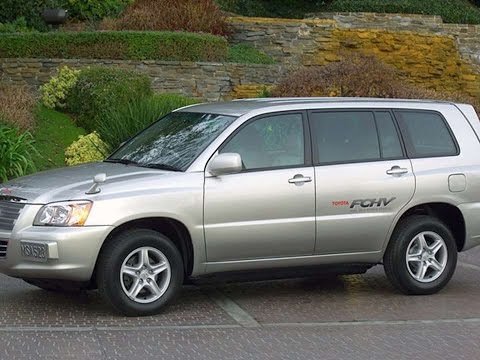
The Toyota FCHV is a hybrid hydrogen fuel cell vehicle development programme of the Toyota Motor Corporation, which was leased to a limited number of drivers in the United States and Japan beginning in 2002. The Toyota FCHV and Honda FCX, which began leasing on 2 December 2002, became the world's first government-certified commercial hydrogen fuel cell vehicles. Its first commercial fuel cell vehicle was developed from the FCHV-4, which was adapted from the Toyota Highlander body. "FCHV" stands ...
More about Toyota FCHV→Added
Know someone who'd love this clip?
Share it with friends and fellow fans.