1964 MORRIS MINI
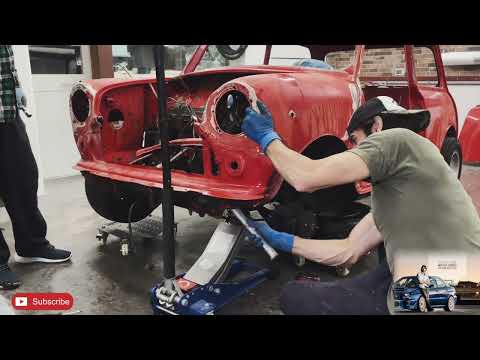
1964 MORRIS MINI COMPACT. The Mini is a two-door compact city car that was produced by the British Motor Corporation (BMC) and its successors from 1959 until 2000. The original Mini is considered an icon of 1960s British popular culture. Its space-saving transverse engine and front-wheel drive layout – allowing 80% of the area of the car's floorpan to be used for passengers and luggage – influenced a generation of car makers. The production version of the Mini was demonstrated to the press in April 1959, and by August, several thousand cars had been produced ready for the first sales. The Mini was officially announced to the public on 26 August 1959. Some 2,000 cars had already been sent abroad and were displayed that day in almost 100 countries. The key dimensions being, wheelbase: 6 ft 8 in (2,032 mm), front track: 3 ft 11.75 in (1,213 mm), rear track: 3 ft 9.9 in (1,166 mm), length: 10 ft 0.25 in (3,054 mm), width: 4 ft 8 in (1,422 mm), height: 4 ft 7 in (1,397 mm), unladen weight: 1,290 lb (590 kg) (approx). The first example, a Morris Mini-Minor with the registration 621 AOK, is on display at the Heritage Motor Centre in Warwickshire. Another early example from 1959 is on display at the National Motor Museum in Hampshire. The Mini was marketed under BMC's two main brand names, Austin and Morris, until 1969, when it became a marque in its own right. The Morris version was known to all as "the Mini" or the "Morris Mini-Minor". This seems to have been a play on words: the Morris Minor was a larger, well known, and successful car that continued in production, and minor is Latin for "lesser", so an abbreviation of the Latin word for "least" – minimus – was used for the new even smaller car. One name proposed for the almost identical Austin version was Austin Newmarket, but it was sold as the Austin Seven (sometimes written as SE7EN in early publicity material – with the '7' using the letter V rotated anticlockwise so it approximated the number 7), which recalled the popular small Austin 7 of the 1920s and 1930s. Until 1962, the cars appeared in North America and France as the Austin 850 and Morris 850, and in Denmark as the Austin Partner (until 1964) and Morris Mascot (until 1981). It was introduced in Australia as Morris 850 only (not "Austin"), and then later as Morris Cooper and Morris Cooper S versions, as well. The Morris name Mini (Mini-Minor) was first used for Austin's version by BMC in 1961 when the Austin Seven was rebranded as the Austin Mini, somewhat to the surprise of the Sharp's Commercials car company (later known as Bond Cars), who had been using the name Minicar for their three-wheeled vehicles since 1949. However, legal action was somehow averted, and BMC used the name "Mini" thereafter. In 1964, the suspension of the cars was replaced by another Moulton design, the hydrolastic system. The new suspension gave a softer ride, but it also increased weight and production cost. In 1971, the original rubber suspension reappeared and was retained for the remaining life of the Mini. From October 1965, the option of the unique Automotive Products designed four-speed automatic transmission became available. Cars fitted with this became the Mini-Matic. Slow at the outset, Mark I sales strengthened across most of the model lines in the 1960s, and production totalled 1,190,000. Ford purchased a Mini and dismantled it to see if they could offer an alternative. Ford determined that the BMC must have been losing around £30 per car, so decided to produce a larger car – the Cortina, launched in 1962 – as its competitor in the budget market. BMC insisted that the way company overheads were shared out, the Mini always made money. Larger profits came from the popular De Luxe models and from optional extras such as seat belts, door mirrors, a heater, and a radio, which would be considered necessities on modern cars, as well as the various Cooper and Cooper S models. The Mini entered into popular culture in the 1960s with well-publicised purchases by film and music stars. CC rating: 1,275cc 78 ci (1.3L) NZ First Registration: 01-Jan-1964
About Sharp's Commercials
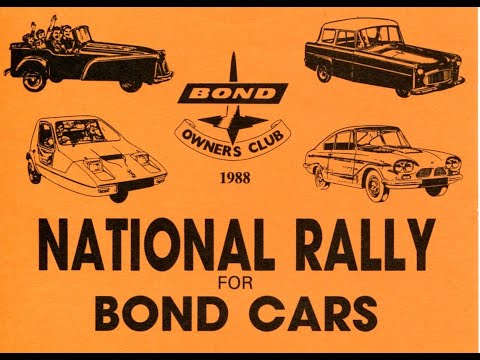
Sharp's Commercials Ltd was a British car maker based in Preston, Lancashire. It was founded in 1922 by Paul Sharp. It changed its name to Bond Cars Ltd in 1963. The company was taken over by the Reliant Motor Co Ltd of Tamworth, Staffordshire in February 1969, who eventually closed the Preston factory at the end of July 1970, transferring the spare parts business for the Bond Minicar, 875 saloon, 875 Ranger van and Equipe models to a firm called Bob Joyner & Son in Oldbury in the English Midlan...
More about Sharp's Commercials→Added
Know someone who'd love this clip?
Share it with friends and fellow fans.