0 views
Share this clip
Know someone who'd love this clip?
Share it with friends and fellow fans.
Share this clip
Know someone who'd love this clip?
Share it with friends and fellow fans.
HOOSIER SWEETHEART - Fox Trot - (Goodwin-Ash-Baskette) - Jean Goldkette and His Orchestra - Vocal refrain by Ray Muerer - Victor 20471-B - Recorded in 1927 /With Bix Beiderbecke. John Jean Goldkette (18 March 1893--March 24, 1962) was a jazz pianist and bandleader born in Patras, Greece. Goldkette spent his childhood in Greece and Russia, and emigrated to the United States in 1911. He led many jazz and dance bands, of which the best known was his Victor Recording Orchestra of 1924 -- 1929, which included, at various times, Bix Beiderbecke, Hoagy Carmichael, Chauncey Morehouse, Jimmy Dorsey, Tommy Dorsey, Bill Rank, Eddie Lang, Frankie Trumbauer, Pee Wee Russell, Steve Brown, Joe Venuti, and arranger Robert Ginzler among others. Vocalists included the Keller Sisters and Lynch. In his Jazz Masters of the Thirties, Rex Stewart, a member of Fletcher Henderson's band at the time, writes that the Goldkette band's innovative arrangements and strong rhythm made it the best dance band of its day and "the first original white swing band in jazz history". The Lexington was an automobile manufactured in Connersville, Indiana, from 1910 to 1927. From the beginning, Lexingtons, like most other Indiana-built automobiles, were assembled cars, built with components from many different suppliers. The Thoroughbred Six and Minute Man Six were popular Lexington models. The Lexington Motor Company was founded in 1909 in Lexington, Kentucky, by Knisey Stone, a Kentucky race horse promoter. Several months later, the company outgrew its building. In 1910, a group of Connersville businessmen noted the community had too much tied up in the buggy and carriage industry, which was being displaced by the growing use of the automobile. The group enticed the infant Lexington Motor Car Company to relocate from Lexington to a new plant at 800 West 18th Street in the McFarlan industrial park, with headquarters at 1950 Columbia Avenue. John C. Moore, the company's chief engineer, immediately started on improvements to the Lexington to keep the company ahead of its competition. His 1911 multiple exhaust was reported to give 30 percent more power on less fuel. Each cylinder had a separate exhaust. Dual exhaust pipes and mufflers were used. The company entered both the Glidden Tour and Indianapolis 500 in 1912. The post-World War I recession of the early twenties destroyed many American automobile manufacturers. Lexington Motor Car Company and United States Automotive Corporation were affected by these recessionary events. Production in 1922 plummeted to roughly a third that of 1920. In 1923, Ansted Engine Company entered receivership, with Durant as a principal shareholder. Lexington also entered receivership in 1923. In 1926 and 1927, respectively, E.L. Cord's Auburn Automobile Company purchased Ansted Engine and the Lexington Motor Car Company. The Lexington was soon phased out. More Info On The Lexington Car: http://en.wikipedia.org/wiki/Lexington_(automobile)
A car, or an automobile, is a motor vehicle with wheels. Most definitions of cars state that they run primarily on roads, seat 1-8 people, have four wheels, and mainly transport people rather than cargo. There are over 1.6 billion cars in use worldwide as of 2025. The French inventor Nicolas-Joseph Cugnot built the first steam-powered road vehicle in 1769, while the Swiss inventor François Isaac de Rivaz designed and constructed the first internal combustion-powered automobile in 1808. The mode...
More about Car→Added
 1:29
1:29Ford v Ferrari
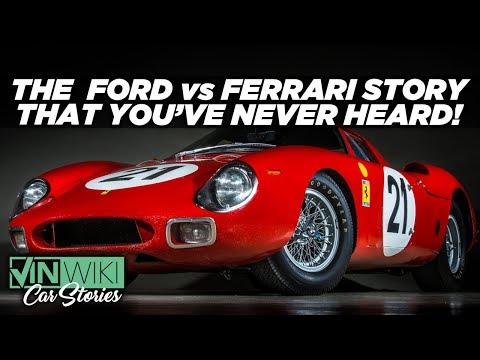 19:50
19:50Maybach, Ferrari, Car
 4:34
4:34Ford v Ferrari
 1:12
1:12Ford v Ferrari